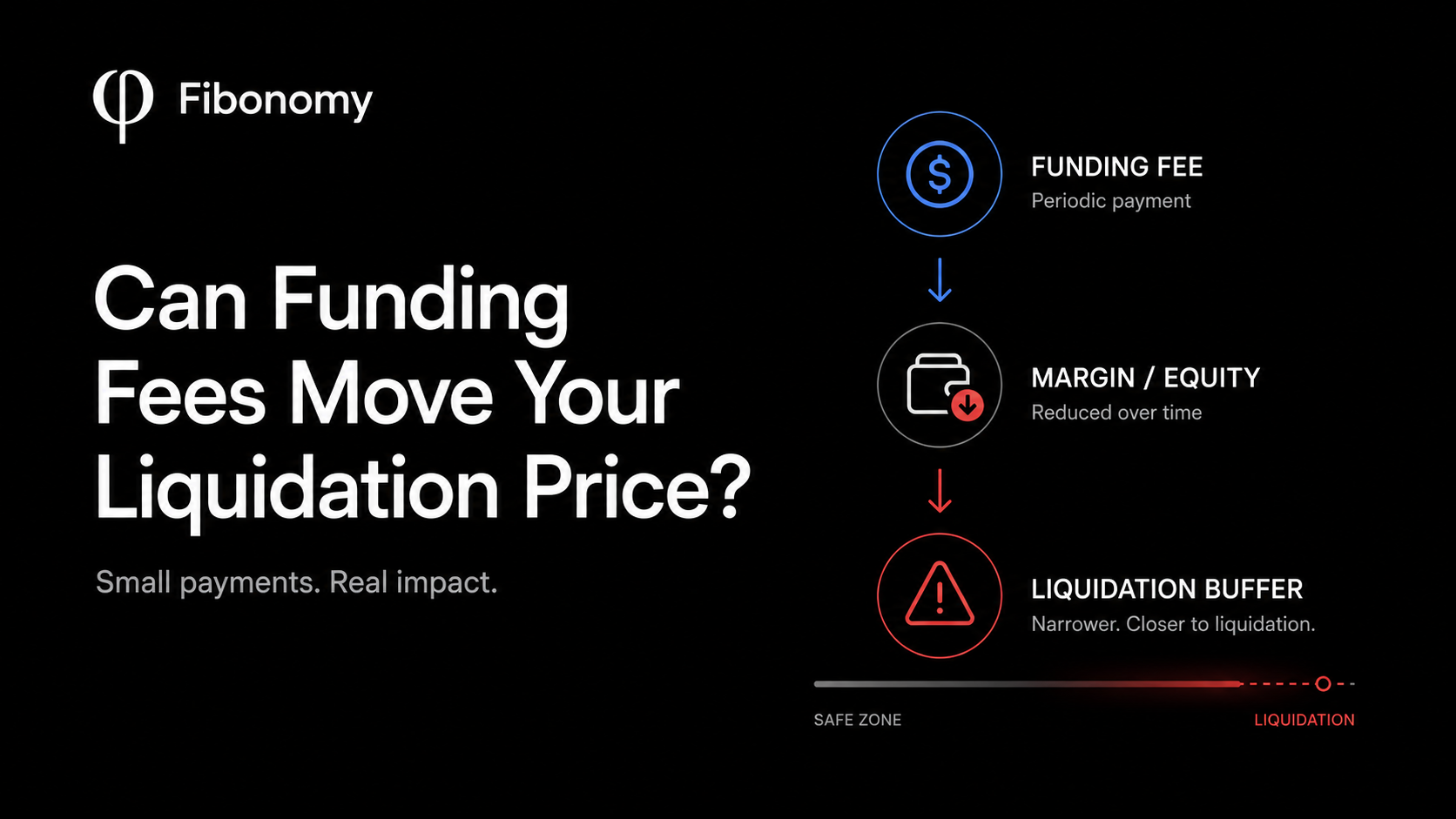
The connection between funding fee liquidation price changes is easy to miss because your account can change even when you place no new trade.
You open a perpetual futures position.
You leave it alone.
No new order.
No change in leverage.
No increase in size.
Then, hours later, the account looks different.
Your available balance is lower.
Your margin buffer may be smaller.
And depending on the exchange and margin mode, the liquidation price or liquidation risk may have changed too.
What happened?
One possible answer is funding.
Quick Answer
Yes—funding fees can affect liquidation conditions.
But not in exactly the same way on every exchange or margin mode.
A funding payment can reduce:
- your available balance,
- the margin supporting an isolated position,
- or the equity supporting a cross-margin account.
Once that happens, the amount of capital available between the position and the exchange’s liquidation threshold can shrink.
On Bybit, if the available balance is insufficient to pay funding in isolated margin, the fee can be deducted from the position’s initial margin; Bybit explicitly states that this moves the liquidation price closer to the mark price and can increase liquidation risk.
On OKX, funding paid in cross margin is deducted from the currency equity of the cross-margin account. OKX states that a reduction in account equity after funding may lead to position reduction or liquidation if the account no longer satisfies the required margin conditions. For how that account-level trigger actually fires, see What Actually Triggers Liquidation in Cross Margin?.
So the useful mental model is:
Funding Payment
      ↓
Balance / Margin / Equity Changes
      ↓
Risk Buffer Changes
      ↓
Liquidation Conditions May Change
The exact path depends on the exchange.
Table of Contents
Funding Is Not a Trading Fee in the Usual Sense
The word “fee” makes funding easy to misunderstand.
For perpetual futures, funding exists to help keep the perpetual contract price aligned with the underlying spot or index price.
At OKX, funding is exchanged between traders rather than retained by the platform:
Positive Funding Rate
Longs → pay → Shorts

Negative Funding Rate
Shorts → pay → Longs
OKX currently calculates:
Funding Fee
=
Position Value × Funding Rate
So funding is different from:
- maker/taker trading fees,
- liquidation fees,
- borrowing interest,
- or ordinary transaction costs.
And because perpetual contracts have no fixed expiry date, funding can keep occurring as long as the position remains open at the relevant settlement times.
A Simple Funding Example
Suppose you hold:
BTCUSDT Long

Position Value     $20,000
Funding Rate         0.03%
At settlement:
$20,000 × 0.03%
=
$6
So:
Funding Payment
$6
That sounds small.
And once, it probably is.
But suppose the position remains open across five settlements at the same rate:
$6 × 5
=
$30
Nothing about the position size had to change.
You did not manually lose another $30 through market movement.
But $30 still left the resources supporting your trading account.
That distinction matters.
How Funding Fee Liquidation Price Changes Can Happen
This is why traders sometimes experience:
“I didn’t change anything, but my liquidation price changed.”
From the trader’s perspective:
No Action
From the account’s perspective:
Funding Settlement
Those are not the same thing.
The account can change even while the trader does nothing.
For example:
12:00

Available Balance       $500
Position Margin       $2,000
Then:
Funding Payment -$40
After settlement:
Available Balance $460
No trade occurred.
But the financial state around the position is no longer identical.
This is one reason holding a perpetual position is not the same as simply freezing its entry state and waiting.
What Happens in Isolated Margin?
Isolated margin gives us the clearest example.
Suppose you have:
Position Margin        $1,000
Available Balance         $0
Funding due:
$25
If the exchange cannot collect that funding from available balance, it may need to take the payment from the resources supporting the position.
Bybit currently documents exactly this behavior for isolated margin.
If available balance is insufficient:
Funding Fee
      ↓
Deducted from Position Initial Margin
      ↓
Position Margin ↓
      ↓
Liquidation Price Moves Toward Mark Price
      ↓
Liquidation Risk ↑
Notice what did not happen:
Position Size        unchanged
Entry Price          unchanged
Market Price         possibly unchanged
Yet liquidation risk increased.
Why?
Because the same position was now being supported by less margin.
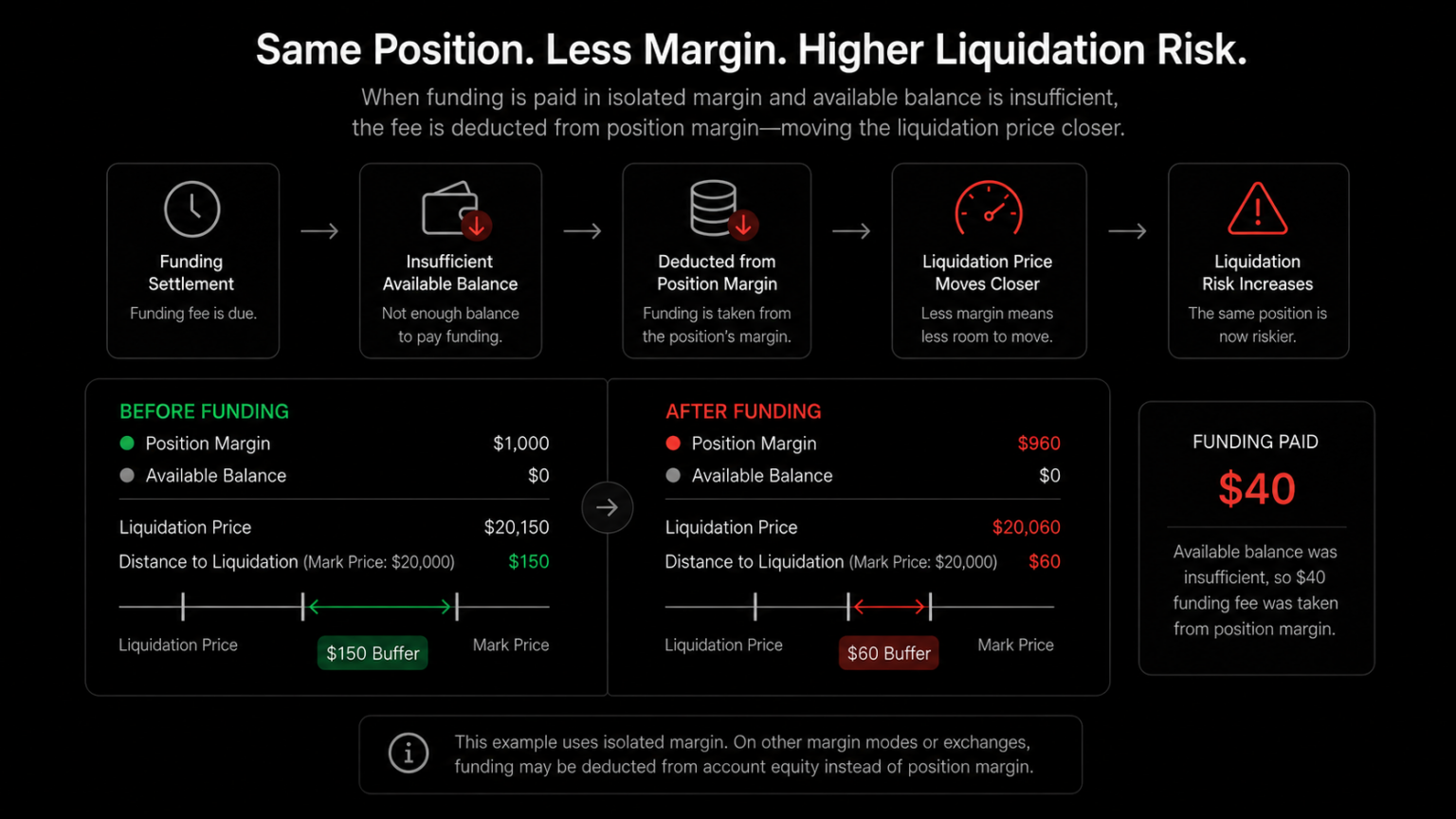
This is a good example of why a liquidation price is an output of several variables—not a permanent characteristic stamped onto the position at entry.
Cross Margin Works Differently
Now consider cross margin.
The position no longer lives inside a completely isolated margin pool.
Instead, the account’s available equity supports multiple positions.
OKX currently states that in cross-margin configurations, funding fees are deducted from the currency equity of the cross-margin account.
The effect is therefore better visualized like this:
ACCOUNT EQUITY

$10,000
   ↓
Funding Payment
-$50
   ↓
$9,950
The exchange may still be supporting:
BTC Position
ETH Position
SOL Position
but now the shared account equity is slightly smaller.
So:
Same Open Positions
+
Less Supporting Equity
=
Different Account Risk State
If the account was already close to a maintenance-margin threshold, even a relatively small deduction can matter more than the absolute funding amount suggests.
This connects directly to the broader cross-margin problem we discussed in How Multiple Open Futures Positions Affect Your Liquidation Risk.
One Funding Payment Usually Isn’t the Whole Story
A $5 or $10 funding payment rarely explains a dramatic account change by itself.
The more interesting cases happen when funding interacts with other changes.
Imagine:
10:00

Account Equity          $10,000
BTC P&L                    -$200
ETH P&L                    -$300
Then the market continues lower:
15:50

BTC P&L                    -$650
ETH P&L                    -$900
Now:
Funding Settlement -$45
The account is being affected by two different mechanisms:
Market Losses
      ↓
Unrealized P&L ↓

Funding
      ↓
Account Equity ↓
The funding payment may only be $45.
But it occurred while the account was already losing equity.
The question is therefore not:
“Was the funding fee large?”
The better question is:
Understanding a funding fee liquidation price change requires tracing where the funding payment was deducted and what supporting balance changed.
“What state was the account already in when funding was deducted?”
That context determines whether funding is irrelevant noise or part of a meaningful deterioration in account risk.
Paying Funding and Receiving Funding Have Opposite Effects
Funding is not always a cost.
When the funding rate is positive:
Longs Pay
Shorts Receive
When it is negative:
Shorts Pay
Longs Receive
So funding can move resources in both directions.
If your account receives funding:
Account Equity ↑
or:
Position Margin ↑
depending on the exchange and margin configuration.
That may improve the account’s margin state.
Again, the exact liquidation-price response depends on the exchange’s calculation model.
This is why the simple statement:
“Funding moves liquidation price closer.”
is incomplete. For the broader mechanics behind a moving liquidation price, see Why Does My Liquidation Price Keep Changing in Cross Margin?.
The more accurate statement is:
Funding changes the financial resources supporting the position or account. Whether that improves or worsens liquidation conditions depends on whether you pay or receive funding and how the exchange applies the settlement.
The Funding Rate Is Only Half the Calculation
Suppose you see:
Funding Rate
0.01%
It looks tiny.
But the fee depends on position value.
Compare:
Position A

Position Value     $2,000
Funding Rate        0.01%

Funding             $0.20
with:
Position B

Position Value    $100,000
Funding Rate         0.01%

Funding            $10.00
Same rate.
Very different payment.
This is why thinking about funding only as a percentage can hide its actual effect.
The basic relationship is:
Funding Impact
depends on:

Funding Rate
×
Position Value
×
Number of Settlements
And then another factor matters:
How large is that payment
relative to available account resources?
A $25 funding payment against a $100,000 account may be immaterial.
The same $25 against a nearly exhausted isolated-margin position can matter much more.
Settlement Frequency Can Change Too
Another assumption traders make is:
“Funding happens every eight hours.”
Often, yes.
But not universally.
OKX currently uses eight-hour funding intervals by default for many contracts, while allowing one-, two-, or four-hour intervals in some cases. It also documents automatic changes in settlement frequency under certain market conditions.
That matters because:
Same Position
+
Same Holding Time
+
More Frequent Funding Settlements
=
Potentially Different Funding History
So when reconstructing the real cost of holding a position, do not assume every contract or every period used the same eight-hour schedule.
Check the actual funding records.
Funding Can Explain Why P&L and Account Balance Feel Inconsistent
Suppose your position shows:
Trading P&L +$300
A trader may naturally expect the account to be roughly $300 better off.
But during the trade:
Funding Paid      -$65
Trading Fees      -$18
Now the economic result is different.
Simplified:
Trading P&L       +$300
Funding            -$65
Trading Fees        -$18
────────────────────────
Net Effect         +$217
That is why looking only at market P&L can give an incomplete picture of what actually happened.
Funding belongs to the position story.
Not because it changed the entry price.
But because holding the position created another account event.
This Is More Important for Long-Held Perpetual Positions
The longer a position remains open, the more opportunities it has to cross funding settlements.
That does not automatically mean the trader will lose money to funding.
Rates can change sign.
You may receive funding during some periods and pay during others.
But the longer the position exists, the less defensible it becomes to look only at:
Entry
↓
Exit
and ignore everything between them.
A more truthful reconstruction is:
Entry
↓
Price Movement
↓
Funding
↓
Position Change
↓
Funding
↓
Fees
↓
More Price Movement
↓
Exit
The final P&L is the end state.
Funding is part of the path that produced it.
A Worked Example
Suppose:
Account Equity          $5,000

BTC Long Position
Position Value          $25,000

Available Balance          $120
Funding rate at settlement:
0.04%
Funding payment:
$25,000 × 0.04%
=
$10
After one settlement:
Available Balance

$120
 ↓
$110
After four identical settlements:
Total Funding Paid
$40

Available Balance
$80
Now imagine the position simultaneously moves against you.
Unrealized P&L:
-$600
The account now has less room from two separate sources:
Market Loss               -$600
Funding                    -$40
The position size did not increase.
But:
Resources supporting risk ↓
If the position is isolated and available balance becomes insufficient, funding may start affecting the position margin itself under exchange rules such as Bybit’s.
If it is cross margin, the same funding history may instead reduce shared account equity, as documented by OKX.
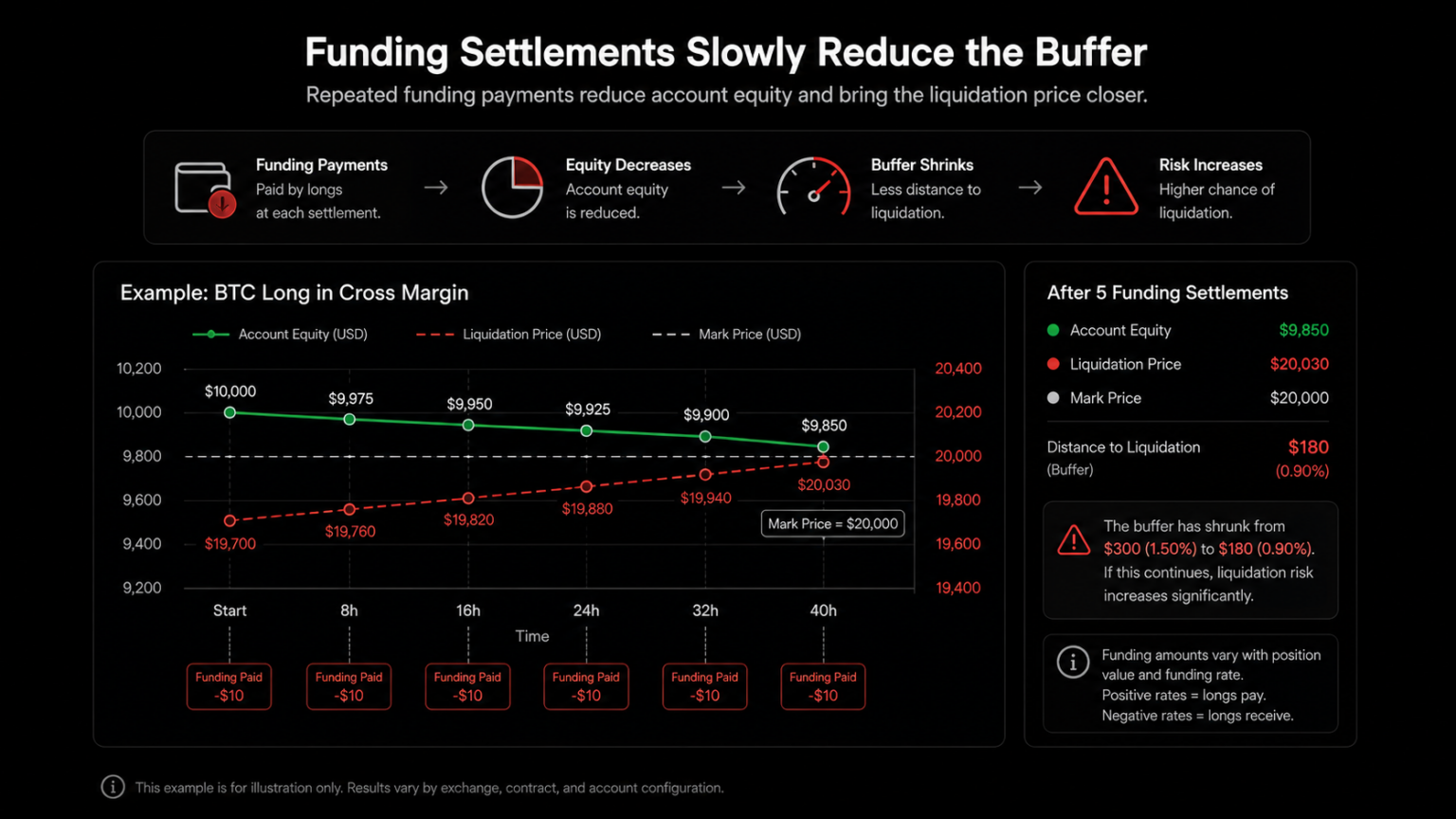
That is the distinction the exchange UI often fails to make obvious.
Funding Does Not Mean You Should Close Before Every Settlement
Once traders understand funding, another shortcut often appears:
“Then I should always close before funding.”
That conclusion does not follow automatically.
Funding is only one component of a trade.
Closing and reopening can introduce:
- trading fees,
- spread,
- slippage,
- lost market position,
- different entry price,
- and execution risk.
Funding itself may also be received rather than paid.
So this article is not an argument for avoiding funding.
It is an argument for seeing it.
A cost you can see can be evaluated.
A cost hidden inside account history is much easier to misinterpret.
What to Check When Funding Settles
If your liquidation situation changes around a funding event, reconstruct these seven things.
1. Did you pay or receive funding?
Check the sign.
Do not assume funding was a cost.
2. How much was actually settled?
Look at the account transaction or funding history.
3. What was the position value?
A small rate can still produce a meaningful payment on a large position.
4. Which margin mode were you using?
Isolated and cross margin can handle the effect differently.
5. Was enough available balance present?
This is especially important on exchanges where insufficient balance causes funding to be taken from position margin.
6. What happened to account equity at the same time?
Funding may be only one contributor among market losses, fees, and other positions.
7. Did liquidation metrics change immediately after settlement?
Compare before and after.
Do not rely on memory.
The Better Question
Instead of asking only:
“Did funding move my liquidation price?”
ask:
“What did this funding settlement change in the resources supporting my position?”
That question works across more exchange designs.
It forces you to look at:
Funding
↓
Where was it deducted from?
↓
What balance or margin changed?
↓
What did that do to account risk?
That is the actual causal chain.
The Bottom Line
Funding can affect liquidation risk even when you make no trading decision.
In isolated margin, a funding payment can reduce the margin supporting the position when available balance is insufficient, potentially moving the liquidation price closer.
In cross margin, funding can reduce the equity shared across the account, changing the state that supports several positions.
And if you receive rather than pay funding, the direction can reverse.
The important point is not:
“Funding always moves liquidation price.”
It does not.
The more accurate statement is:
Funding changes the money supporting the position or account. When that supporting capital changes, liquidation conditions can change with it.
So when a liquidation number moves and you think nothing happened, check the account history.
Something may have happened after all.
See What Changed Behind the Number
Fibonomy reconstructs changes across your open positions and account so funding, position changes, P&L, and risk do not remain disconnected numbers.
See My Positions →
This content is for educational purposes only and does not constitute financial, investment, or trading advice. Funding, margin, and liquidation mechanics vary by exchange, product, margin mode, account configuration, and market conditions.
Sources
Bybit — Funding Fee Calculation
How funding is calculated and deducted, including the effect on isolated position margin and liquidation price when available balance is insufficient.
OKX — Perpetual Futures Funding Fee Mechanism
Funding direction, calculation, settlement frequency, cross-margin equity deductions, and potential liquidation impact.
OKX — Perpetual Futures Funding Fee FAQ
How funding works between long and short position holders.
OKX — How Does Liquidation Work in Futures Trading?
Liquidation mechanics and treatment of unsettled funding in liquidation outcomes.