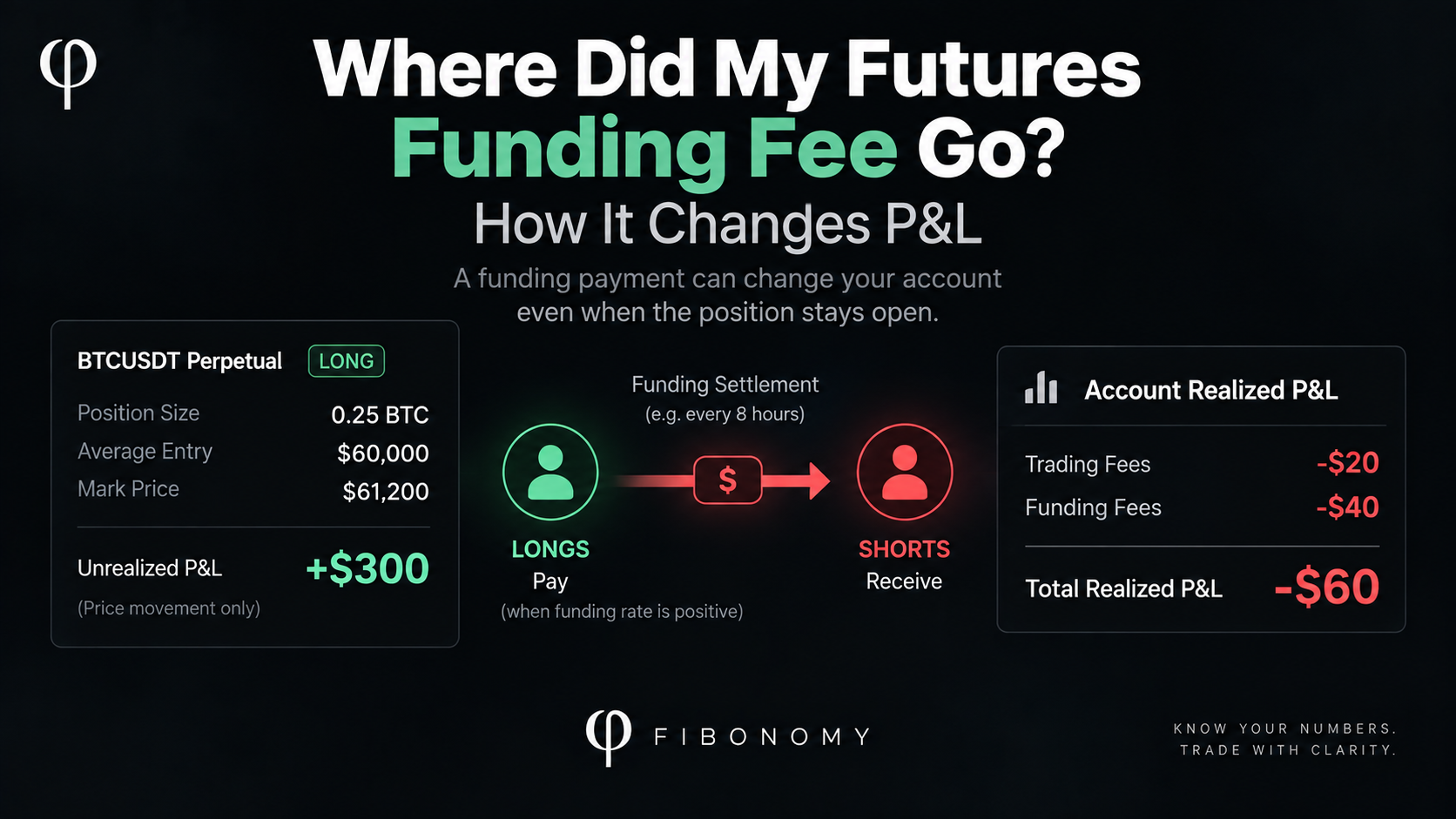
A futures funding fee can change your trading result even when you do not open, close, or resize a position.
You are LONG BTCUSDT.
Nothing changes for several hours.
Position Size:
0.25 BTC

Average Entry:
$60,000

Market Price:
$61,200
Your position is profitable.
Then a funding settlement happens.
Your position still shows the same:
0.25 BTC
Your average entry still shows:
$60,000
But your account balance—or realized P&L—has changed.
Where did the money go?
The short answer:
Funding is a separate account event from the price P&L of your position.
It can be paid or received while the position remains open.
That means the number beside your open trade may tell one story while your account tells another.
Quick Answer
A futures funding fee is a periodic payment exchanged between traders holding opposite sides of a perpetual futures market.
Generally:
Positive Funding Rate

LONGS
  ↓
Pay
  ↓
SHORTS
and:
Negative Funding Rate

SHORTS
  ↓
Pay
  ↓
LONGS
The exchange facilitates the transfer, but on Binance, Bybit, and OKX the funding payment itself is exchanged between opposing position holders rather than kept by the exchange as a normal trading commission.
A simplified funding calculation is:
Funding Payment
=
Position Value
×
Funding Rate
But where the resulting payment appears can depend on:
- the exchange,
- Cross vs Isolated Margin,
- account type,
- whether you paid or received funding,
- and which P&L field you are looking at.
That is why:
Price P&L

≠

Final Economic Result
Table of Contents
Funding Does Not Change Your Entry Price
Start with the simplest distinction.
Suppose:
BTCUSDT LONG

Size:
0.25 BTC

Entry:
$60,000

Mark Price:
$61,000
Your position has:
Price Move:
+$1,000
Approximate position P&L:
0.25 BTC
×
$1,000

=

+$250
Now suppose you pay:
Funding:
-$20
Your average entry does not suddenly become:
$60,080
The funding payment is not another BTC fill.
It is a separate cash-flow event associated with holding the perpetual position.
So you now have:
Market P&L:
+$250

Funding:
-$20
Those need to be kept separate before they can be combined.
How a Futures Funding Fee Changes P&L
This is where exchange interfaces can become confusing.
A trader may see:
Unrealized P&L
+$250
after funding was paid and assume:
“Funding didn’t affect my trade.”
But that only tells you that the unrealized position P&L field may not include funding.
For example, Bybit currently distinguishes them explicitly:
Unrealized P&L
=
Position price movement
while its Closed P&L includes:
Position P&L

-
Opening Fee

-
Closing Fee

-
Funding Fees
Its Realized P&L also includes trading fees, funding and P&L already realized through reductions or partial closes.
So:
Unrealized P&L unchanged
does not mean:
Account unchanged
A Simple Funding Example
Suppose:
BTCUSDT LONG

Position Value:
$25,000
Funding rate:
0.04%
Funding payment:
$25,000
×
0.04%

=

$10
Assume positive funding.
The long pays:
-$10
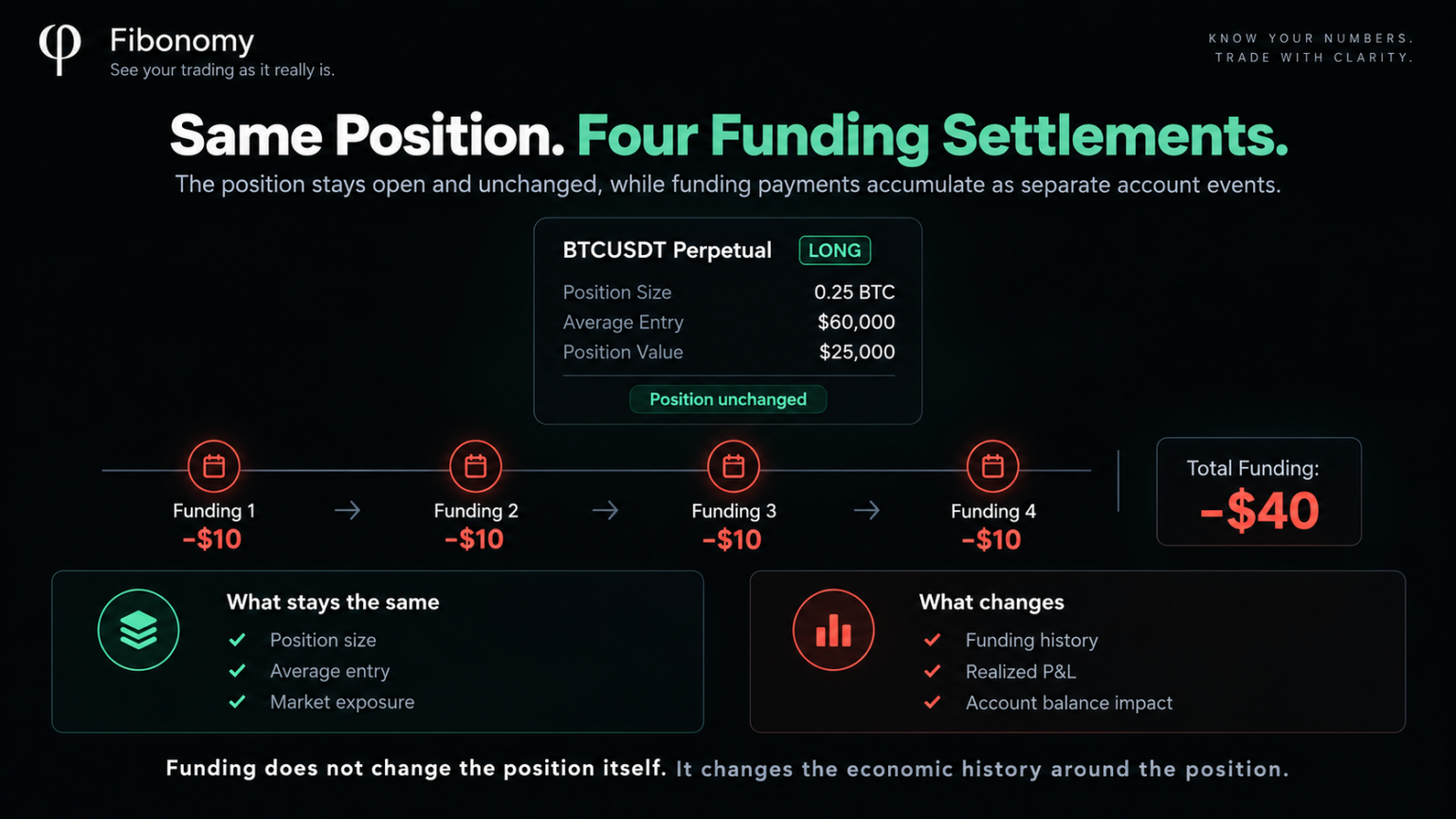
After one settlement:
Funding History

-$10
After four identical settlements:
-$10
-$10
-$10
-$10
────
-$40
Nothing about this requires:
- another trade,
- another fill,
- a changed entry,
- or a changed position size.
The position can remain:
0.25 BTC LONG
while the economic history around it changes by:
-$40
Binance, Bybit and OKX all currently calculate funding broadly from position value and the applicable funding rate, although their exact contract and account implementations differ.
Funding Can Reduce a Profitable Trade
Now suppose that trade eventually produces:
Gross Price P&L:
+$120
Trading fees:
-$20
Funding history:
-$40
Final simplified result:
Gross Price P&L      +$120

Trading Fees          -$20

Funding               -$40
───────────────────────────

Net Result             +$60
The trade was profitable.
But only half of the gross price profit survived.
Now change one number.
Suppose gross price P&L was only:
+$50
Then:
Gross Price P&L       +$50

Trading Fees          -$20

Funding               -$40
───────────────────────────

Net Result             -$10
Price direction:
WINNER
Economic result:
LOSER
This is one of the reasons a list of green trades does not necessarily tell you whether the account actually made money.
We reconstructed that broader mismatch in Why Is My Futures P&L Negative When My Closed Trades Are Profitable?.
Funding Can Be Received, Not Just Paid
Funding is not automatically a cost.
Suppose the funding rate is negative.
In the typical perpetual funding relationship:
SHORTS PAY

LONGS RECEIVE
Now imagine you are LONG.
Position price P&L:
+$80
Funding received:
+$25
Trading fees:
-$12
Simplified net:
+$80
+
$25
-
$12

=

+$93
Funding improved the result.
So it is more accurate to think of funding as:
Funding Cash Flow
rather than:
Always a Fee Against Me
Binance, Bybit and OKX all document that the direction of the payment depends on the sign of the funding rate and the side of the position.
You Only Pay or Receive Funding If You Hold the Position at Settlement
Suppose a contract settles funding at:
08:00 UTC
You close at:
07:55 UTC
For that funding cycle, you generally do not participate because you no longer hold the position when funding is assessed.
If you remain open through the assessment:
Position Open at Funding Time
        ↓
Funding Applies
Binance states that funding applies when the position is open at the specified funding time. Bybit and OKX document the same basic principle, while also warning that actual settlement processing can occur within a small time window around the scheduled event.
This does not imply:
“Always close before funding.”
Closing and reopening creates other events:
- trading fees,
- spread,
- slippage,
- a potentially different entry,
- execution risk,
- and the possibility of missing the move.
Funding is one input.
Not the entire trading decision.
Funding Is Not Always Every Eight Hours
A common shortcut is:
“Funding happens every eight hours.”
That is often true.
It is not universal.
Binance currently documents eight hours as the default interval for many perpetual contracts, while allowing the interval to be adjusted in some market conditions.
Bybit states that different trading pairs can have different funding intervals.
OKX currently supports funding intervals including:
1 hour

2 hours

4 hours

8 hours
depending on the contract and market conditions.
So if you are reconstructing an old position, do not assume:
Holding Time
÷
8 hours
=
Number of Funding Events
Use the actual funding history.
Position Value Matters More Than the Leverage Label
Funding is generally calculated from the value of the position.
Not directly from:
10x
or:
20x
Consider two traders.
Trader A
Position Value:
$25,000

Selected Leverage:
5x
Trader B
Position Value:
$25,000

Selected Leverage:
20x
If the relevant funding calculation uses the same:
$25,000 Position Value
and:
0.04% Funding Rate
then the simplified funding amount is:
$10
for each.
Changing leverage alone does not automatically multiply the funding payment if the actual position value remains unchanged.
That follows the same distinction we covered in Why Changing Leverage Doesn’t Always Change Risk the Way You Expect:
Leverage
≠
Position Size
Funding cares about the exposure being funded.
Increasing Position Size Can Increase the Next Funding Payment
Now change the position.
Before:
Position Value:
$25,000

Funding Rate:
0.04%
Funding:
$10
You size up.
New position value:
$50,000
Same funding rate:
0.04%
New simplified funding:
$50,000
×
0.04%

=

$20
Your funding exposure doubled because your position exposure doubled.
Not because the leverage number itself changed.
This connects directly to What Happens to Liquidation Risk When You Add to a Futures Position?.
Adding to a position can change:
- average entry,
- position size,
- maintenance requirements,
- liquidation conditions,
- capital at risk,
- and future funding amounts.
One size change can affect several later account events.
Why Funding May Appear in Realized P&L Before the Position Is Closed
This is an important interface detail.
A common mental model is:
Position Open
=
Nothing Realized Yet
That is too simple.
Funding itself is already an account event.
Bybit’s current Realized P&L definition includes funding fees accumulated while the position remains open.
CoinEx likewise states that Realized PNL includes:
- funding fees,
- trading fees,
- and P&L from reducing or closing positions.
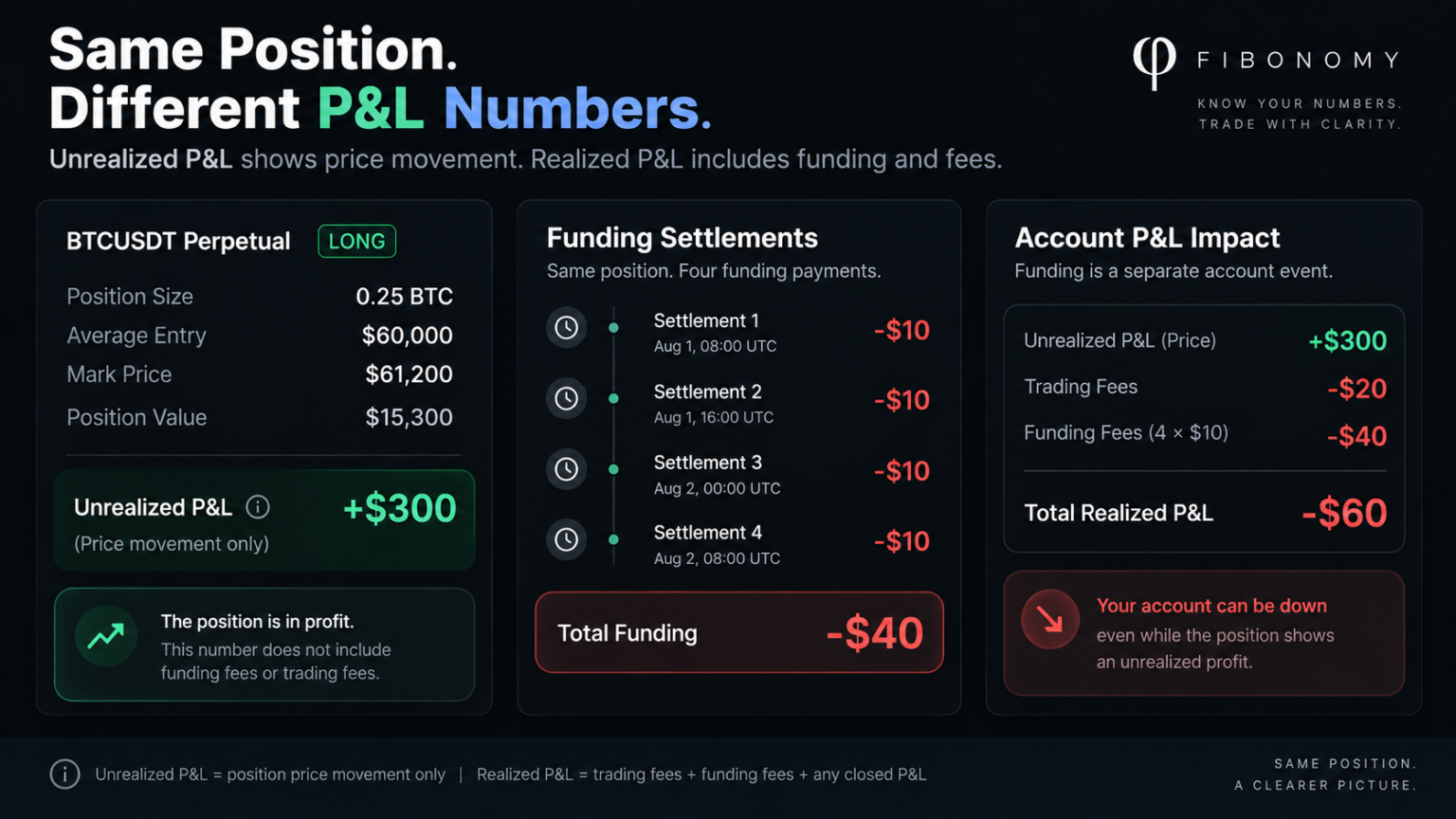
So this is possible:
POSITION STILL OPEN

Unrealized P&L       +$300

Realized P&L          -$45
Why?
Possibly:
Funding              -$35

Opening Fee          -$10
No contradiction.
One field describes the still-open market position.
The other contains account events that have already happened.
Cross Margin: Funding Can Change the Shared Account
Now we move from P&L to account state.
Suppose you are using Cross Margin.
You hold:
BTCUSDT LONG

ETHUSDT LONG

SOLUSDT SHORT
Funding is paid on BTC:
-$40
The BTC position quantity does not change.
But the shared account may now have:
$40 Less Supporting Equity
OKX currently states that in Cross Margin, funding is deducted from or credited to the currency equity of the cross-margin account.
That means one funding event can simultaneously be:
A P&L / cash-flow event
and:
An account-risk event
This second effect is what we covered in Can Funding Fees Move Your Liquidation Price?.
Same funding payment.
Different question.
This article asks:
Where did it go in the economics of the trade?
That article asks:
What did it do to the account supporting the position?
Isolated Margin Can Behave Differently
In Isolated Margin, the funding payment may interact more directly with the resources supporting that individual position.
Bybit currently documents that funding is first deducted from available balance. If the available balance is insufficient, the funding fee can be deducted from the position’s Initial Margin in Isolated Margin, which can move liquidation price closer to Mark Price.
OKX states that in Isolated Margin, funding is deducted from or credited to the isolated margin of the position.
So even if two users both see:
Funding Paid
-$20
the account-level consequence can differ depending on margin mode.
That is another reason not to reconstruct funding from one number alone.
Where Did the Funding Fee Actually Go?
When you see:
Funding
-$35
trace the event.
Ask:
1. Which position generated it?
BTCUSDT?
ETHUSDT?
SOLUSDT?
2. What was the position value at settlement?
Funding is tied to the position value at the relevant funding event.
3. What was the actual funding rate?
Do not use today’s rate to reconstruct yesterday’s payment.
4. Was the position long or short?
The sign of the funding rate alone is not enough.
You need the position direction.
5. Was funding paid or received?
-$35

or

+$35?
6. What margin mode was active?
Cross

or

Isolated?
7. Where does this exchange record funding?
Check:
- transaction history,
- funding history,
- realized P&L,
- closed P&L,
- account ledger.
8. Did position size change before the settlement?
If you added or partially closed beforehand, the position value used for funding may differ from what you remember.
9. How many settlements occurred?
Do not assume one.
A long-held position may accumulate multiple funding events.
Funding History Belongs to the Position Lifecycle
A trade is often remembered like this:
OPEN
  ↓
PRICE MOVES
  ↓
CLOSE
But the actual lifecycle can be:
OPEN BTC

↓

FUNDING -$10

↓

ADD TO BTC

↓

FUNDING -$18

↓

PARTIAL CLOSE

↓

FUNDING -$9

↓

FINAL CLOSE
Now ask:
“How much did this position make?”
You cannot answer accurately from entry and exit alone.
You need:
Trading P&L

± Funding History

- Trading Fees

± Partial Realizations
Funding is not background noise.
It is part of the position’s financial history.
A Worked Example: The Same Trade Before and After Funding
Suppose:
BTCUSDT LONG

Initial Position Value:
$20,000
The trade remains open through four settlements.
Funding 1
-$8
Funding 2
You added to the position before the next settlement.
Position value increases.
-$13
Funding 3
-$12
Funding 4
You partially closed before settlement.
-$7
Total:
-$8
-$13
-$12
-$7
────
-$40
Eventually the position closes with:
Gross Price P&L:
+$150
Trading fees across:
- opening,
- adding,
- partial close,
- final close
total:
-$28
Final simplified result:
Gross Price P&L       +$150

Trading Fees           -$28

Funding                -$40
───────────────────────────

Net Result              +$82
Now compare:
What the chart suggests

+$150
with:
What the position actually produced

+$82
That $68 difference has events behind it.
Nothing disappeared.
Why “Funding Rate” Is Not the Same as “Funding Paid”
Suppose the interface says:
Funding Rate
0.04%
That does not tell you your funding amount by itself.
You still need the relevant position value.
Example:
Trader A Position
$5,000
Funding:
$5,000 × 0.04%
=
$2
Trader B:
Position
$50,000
Funding:
$50,000 × 0.04%
=
$20
Same rate.
Ten times the payment.
So:
Funding Rate
≠
Funding Amount
The rate describes the price of funding.
The position value determines how much of that rate applies to you.
Why Today’s Funding Rate Cannot Reconstruct an Old Trade
Funding rates change.
Settlement intervals can also change.
Position size can change.
So you cannot reliably reconstruct:
Trade held for 3 days
using:
Today's Funding Rate
×
3 days
The actual reconstruction requires:
Funding Event 1
Rate + Position Value

Funding Event 2
Rate + Position Value

Funding Event 3
Rate + Position Value

...
Binance, Bybit and OKX all maintain funding histories precisely because funding is event-based rather than one permanent rate attached to a position.
A Funding Payment Can Affect More Than One Metric
One settlement may cause several visible changes.
For example:
Funding Settlement
-$20
might produce:
Funding History       -$20

Realized P&L          ↓

Available Balance     ↓

Account Equity        ↓
and depending on the margin mode and exchange:
Liquidation Buffer
may also change
But:
Position Size
=
Same
and:
Average Entry
=
Same
That is a classic Fibonomy problem:
Several numbers changed because of one event, while other important numbers did not.
Without reconstructing the event, the interface can make those changes look unrelated.
Do Not Double-Count Funding
This matters when you calculate your own P&L.
Suppose an exchange defines:
Closed P&L
as already including:
Funding
You export Closed P&L:
+$200
Then separately subtract:
Funding
-$40
You may accidentally calculate:
+$160
even though the exchange’s $200 already included that funding.
The problem is not arithmetic.
It is definition.
Before combining fields, ask:
Does this P&L field already include funding?
Bybit explicitly includes funding in its Closed P&L formula, while CoinEx includes funding in Realized PNL.
This is why field semantics matter before reconciliation.
The Better Question
Do not ask only:
“How much funding did I pay?”
Ask:
“Which funding events happened during this position, where were they recorded, and what did each one change?”
Reconstruct:
Position Open

      ↓

Funding Settlement

      ↓

Paid or Received?

      ↓

Realized P&L Changed?

      ↓

Balance / Equity Changed?

      ↓

Margin State Changed?

      ↓

Position Size Changed Later?

      ↓

Next Funding Settlement
Now funding becomes part of an explainable lifecycle.
Not a mysterious deduction.
The Bottom Line
A futures funding fee is not the same thing as trading P&L.
It is a separate cash-flow event created by holding a perpetual futures position through a funding settlement.
It can:
- reduce or increase realized P&L,
- change available balance,
- accumulate across multiple settlements,
- change as position size changes,
- affect shared equity in Cross Margin,
- affect isolated position support,
- and contribute to the difference between a profitable chart move and the final economic result.
But it does not automatically:
- change your position size,
- change your average entry,
- or change the raw price movement that created your market P&L.
So when funding appears in your history, do not ask:
“Where did this random fee come from?”
Ask:
“What position was open at that settlement, what was its value, what was the rate, and where did the resulting cash flow show up?”
That turns funding from a mysterious line item into a reconstructable event.
See Every Event Behind the Position
Fibonomy reconstructs the events surrounding your futures positions—fills, size changes, funding, fees, realized P&L, and account impact—so you can see where the final result actually came from.
See My Positions →
Not a signal. Funding intervals, calculations, account treatment and P&L definitions vary by exchange, contract and margin mode.
Sources
Binance Futures — Introduction to Binance Futures Funding Rates
Funding direction, funding amount, settlement timing and the relationship between position value and funding rate.
Binance Futures — What Fees Are Generated in Binance Futures Trading?
The distinction between trading commission and funding payments in Binance Futures.
Bybit — Funding Fee Calculation
How funding is calculated, when it applies, how it is deducted and how Isolated Margin can be affected.
Bybit — P&L Calculations for USDT Perpetual and Expiry Contracts
How funding enters Closed P&L and Realized P&L while remaining separate from Unrealized P&L.
OKX — Perpetual Funding Fee Mechanism
Funding calculation, settlement intervals and how funding is credited or deducted in Cross and Isolated Margin.
OKX — Perpetual Futures Funding Fee FAQ
Funding direction, historical records, settlement timing and the relationship between funding fees and P&L.
CoinEx — How to Calculate USDⓈ-Margined Contract Equity and PNL
Funding inside Realized PNL and the relationship among Realized PNL, Unrealized PNL and account equity.
CoinEx — Margin Terms
How Realized PNL includes funding, trading fees and position-reduction or closing P&L.