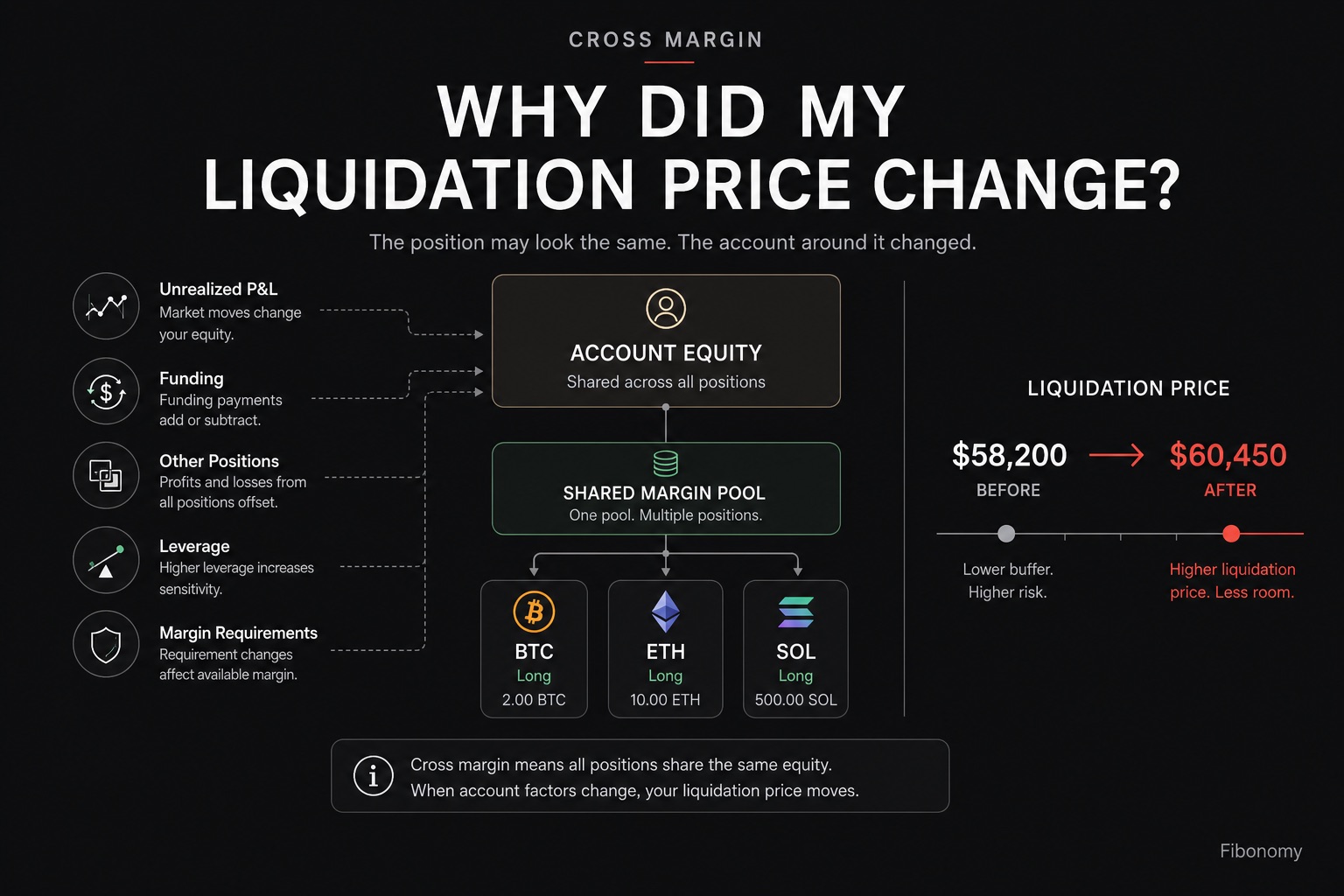
If you’re wondering why liquidation price changes in cross margin, the answer is usually not limited to the position you’re looking at.
Liquidation price changes in cross margin because the position is supported by a shared account whose equity, P&L, funding, and margin requirements can change.You open a futures position and your exchange shows a liquidation price.
Later, you check again.
The position is still open. Your entry price may be the same. You may not have placed another order.
But the liquidation price has moved.
So what changed?
The important thing to understand is this:
In cross margin, a position does not live alone. It is supported by an account whose equity, open positions, unrealized P&L, funding, and margin requirements can keep changing.
That means the liquidation price you see is not necessarily a fixed property of that one position.
It is an output of a changing account state.
Quick answer
In cross margin, available margin is shared across positions. Changes in account equity, unrealized P&L, other open positions, funding payments, position size, leverage, and margin requirements can therefore change your liquidation conditions. The exact calculation varies by exchange and account mode. For how several open futures positions share that same equity pool, see how multiple open futures positions affect liquidation risk.
Table of Contents
Bybit, for example, calculates cross-margin risk at the account level in its Unified Trading Account, using account maintenance-margin measures rather than treating every position as completely independent.
Why Liquidation Price Changes in Cross Margin
With isolated margin, the basic mental model is relatively simple:
BTC Position
     ↓
Dedicated Margin
     ↓
Position Risk
Cross margin is different.
Think of it more like this:
                 ACCOUNT
                    │
              Shared Equity
                    │
       ┌────────────┼────────────┐
       │            │            │
      BTC          ETH          SOL
       │            │            │
       └────────────┼────────────┘
                    │
            Account Risk State
                    │
               Liquidation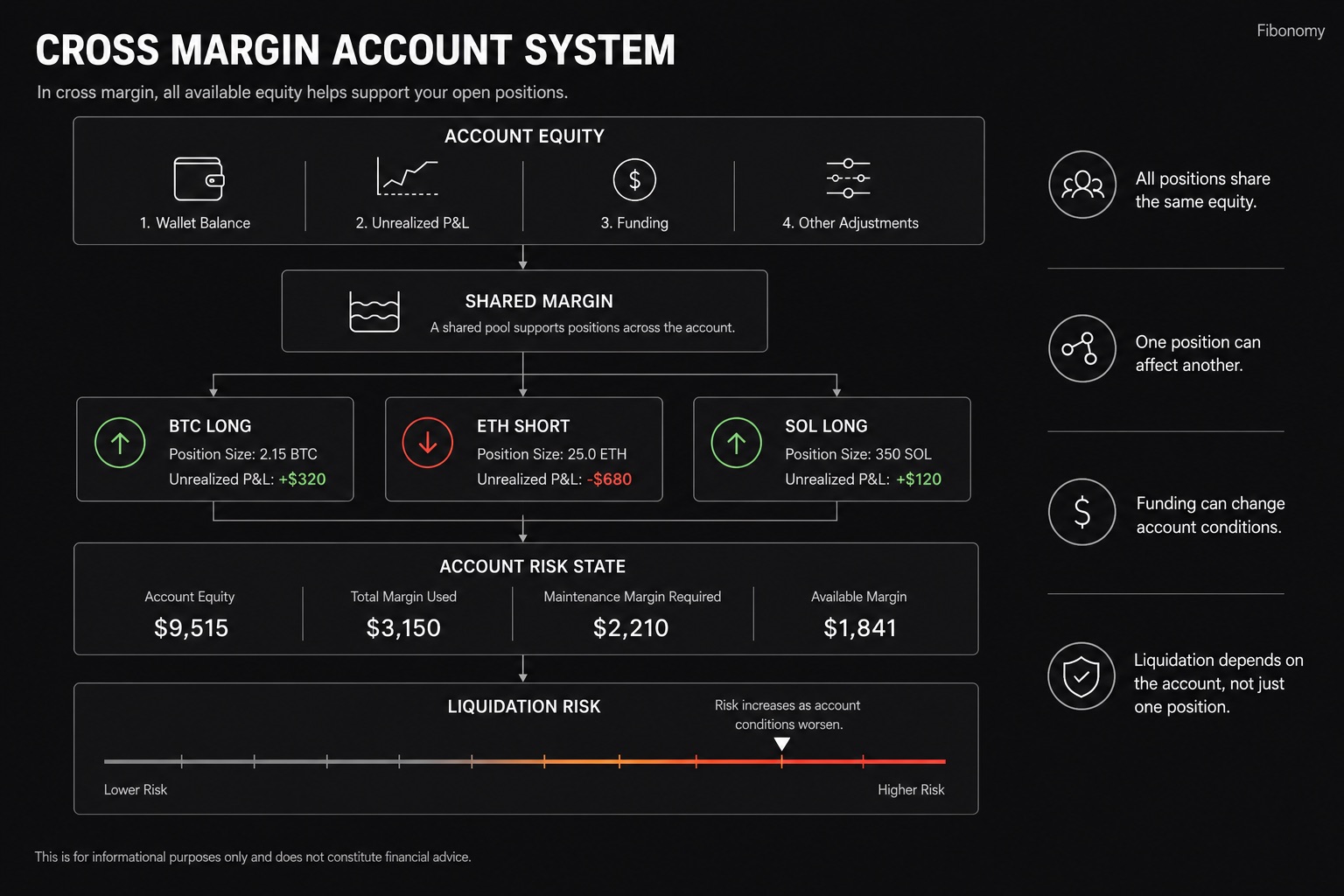
All available margin in the cross-margin account can contribute to supporting positions. Bybit explicitly describes cross margin as using the account’s available margin across open positions, while OKX similarly states that the account balance is used as margin in cross-margin mode.
This creates an important distinction:
Position state
is not always the same thing as:
Account state.
And liquidation in cross margin is fundamentally tied to the second.
1. Unrealized P&L Changes the Account Supporting Your Position
Imagine you have two open positions:
BTC Long
Unrealized P&L       +$300

ETH Long
Unrealized P&L       -$900
If you look only at BTC, everything may appear fine.
But across the account:
BTC                   +$300
ETH                   -$900
──────────────────────────
Net Unrealized P&L    -$600
That matters because unrealized profit and loss can contribute to the margin balance used by cross-margin systems.
For example, Bybit’s current documentation defines cross-margin balance using wallet balance plus perpetual and futures unrealized P&L.
So nothing necessarily had to change inside your BTC position.
What changed was the account surrounding it.
2. Another Position Can Change Your Liquidation Risk
Now imagine this account:
Account Equity        $10,000

BTC Long
$8,000 position

Other positions
None
Then you open another large futures position:
ETH Long
$12,000 position
Your BTC entry price did not change.
Your BTC position size did not change.
But the account now has another position requiring margin and contributing to account-level risk. For what actually trips liquidation at that account level, see What Actually Triggers Liquidation in Cross Margin?.
Under cross margin, these positions are not completely independent.
This is why the question:
“What is the liquidation price of my BTC position?”
can be incomplete.
A better question is:
“What is happening across the account that is supporting my BTC position?”
This becomes especially important with multiple cross-margin positions. OKX even notes that under some cross-margin configurations, when multiple futures or leveraged positions are present, a single estimated liquidation price may not be available because account-level interactions make that simplification inappropriate.
3. Funding Can Change Your Account Even When You Do Nothing
Perpetual futures use funding payments. How those payments move margin, equity, and liquidation conditions is covered in Can Funding Fees Move Your Liquidation Price?.
That means your account can change even if you:
- do not open another trade,
- do not change leverage,
- do not increase the position,
- and do not manually move margin.
Funding still occurs.
Under OKX’s current cross-margin mechanism, funding is deducted from the equity of the cross-margin account.
So the sequence can look like this:
No trading action
      ↓
Funding payment
      ↓
Account equity changes
      ↓
Margin state changes
      ↓
Liquidation risk changes
This is one reason traders sometimes say:
“I didn’t change anything. Why did my liquidation situation change?”
Because you may not have changed the position, but something changed in the account.
4. Adding to a Position Changes More Than Its Size
Suppose your BTC position is:
Position Size
$5,000
Then you add to it:
New Position Size
$12,000
It is tempting to think the only change was:
$5,000 → $12,000But increasing a position can also affect:
- average entry price,
- position exposure,
- initial margin,
- maintenance margin,
- available account margin,
- and the account’s distance from liquidation.
The position can also move into another risk tier depending on the exchange’s rules. For a full walk-through of what changes when you size up — average entry, capital at risk, maintenance margin, and liquidation price — see What Happens to Liquidation Risk When You Add to a Futures Position?.
So a position increase is better represented as:
Position Size Changed
        ↓
Position State Changed
        ↓
Margin Requirements Changed
        ↓
Account State Changed
        ↓
Liquidation Risk May Change
This is a recurring problem in exchange interfaces: you see the new number, but not always the full chain of changes that produced it.
See the account behind the position
What are your positions really doing to your account?
Connect your exchange. See margin, funding, and liquidation in one place.
5. Changing Leverage Can Change the Margin Picture
Leverage is another source of confusion.
A trader may think:
“I changed leverage from 10x to 20x. That’s the only thing that changed.”
But leverage affects margin requirements.
Changing those requirements can change how much account equity remains available to support positions.
This gets even more important in cross margin because one position exists inside a shared account.
The correct mental model is therefore not:
10x → 20xIt is:
Leverage Changed
       ↓
Required Margin Changed
       ↓
Available Margin Changed
       ↓
Account Risk State Changed
The exact consequence depends on the exchange and account configuration, so leverage should not be treated as a universal standalone measure of how much capital is actually at risk.
6. The Price on Your Chart May Not Be the Price That Matters for Liquidation
There is another source of confusion:
Last Price and Mark Price are not necessarily the same thing.
Many futures venues use a mark or reference price as part of their liquidation system rather than simply using the latest traded price.
This exists to reduce the chance that short-lived price manipulation or abnormal prints trigger unnecessary liquidations.
The practical consequence is important.
You may look at your candle chart and think:
“The market never traded at my liquidation level.”
But the price relevant to the exchange’s risk engine may not be the exact price you were watching on that chart.
So whenever a liquidation seems impossible, one of the first things to check is:
What price am I looking at?

versus

What price does the exchange use
for its liquidation calculation?
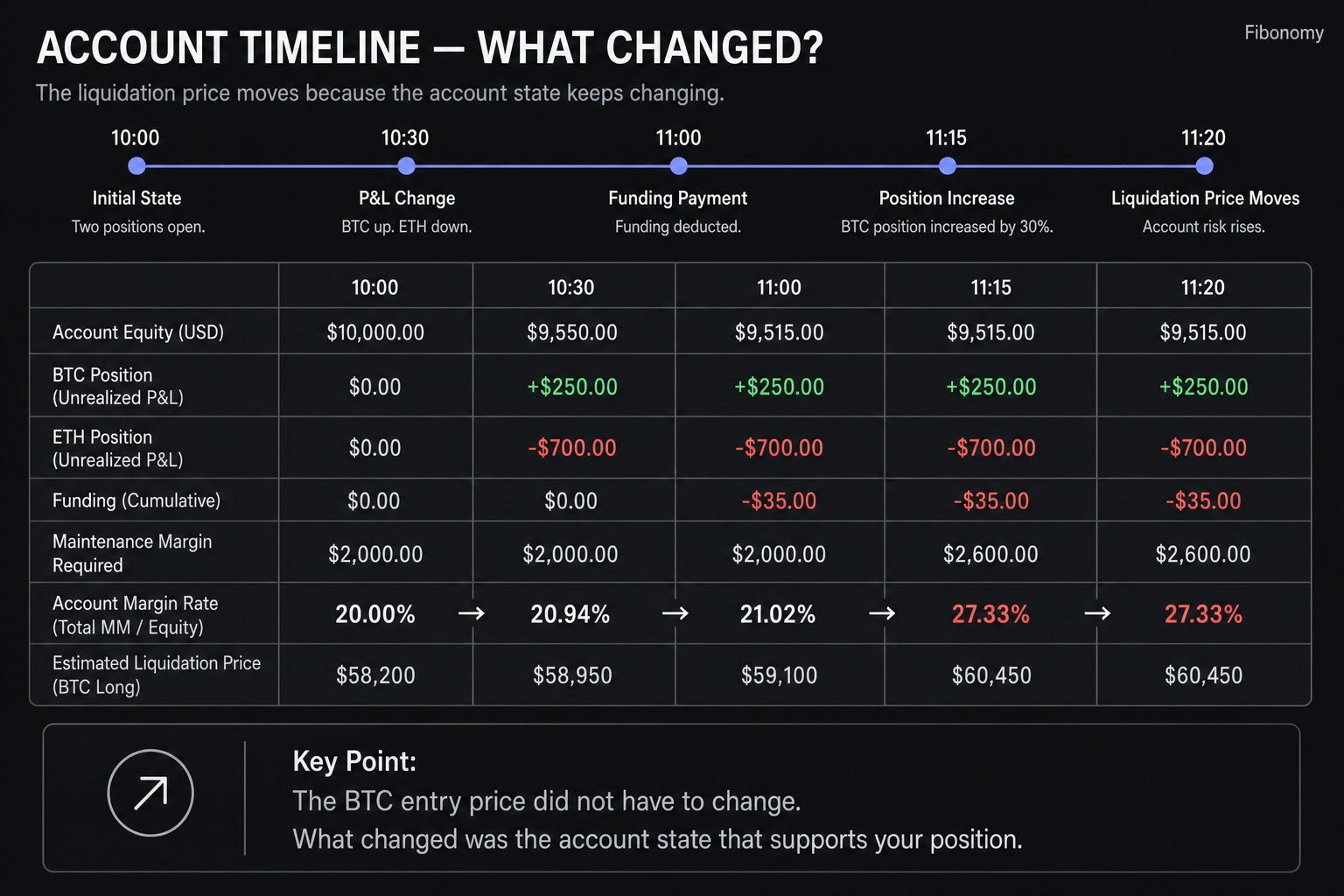
A Worked Example
Consider this simplified account:
10:00

Account Equity             $10,000

BTC Position
Unrealized P&L                  $0

ETH Position
Unrealized P&L                  $0
Everything initially looks stable.
Then:
10:30

BTC Unrealized P&L           +$250
ETH Unrealized P&L           -$700

Net Unrealized P&L           -$450
Later:
11:00

Funding Payment               -$35
Then:
11:15

BTC Position Size             +30%
Compare the account:
10:00
Two positions
No unrealized loss
No new funding payment

            ↓

11:15
Net unrealized loss
Funding deducted
BTC position increased
The BTC entry price did not need to change for the account to become materially different.
The position you were watching may look similar.
The system around that position is not.
This distinction is the core of understanding cross-margin liquidation.
Liquidation Price Is an Output, Not the Explanation
A liquidation number can be useful.
But the number itself does not explain how you got there.
Behind it may be:
Account Equity
      +
Unrealized P&L
      +
Other Open Positions
      +
Funding
      +
Position Size
      +
Leverage
      +
Margin Requirements
      ↓
Account Risk State
      ↓
Liquidation Conditions
Looking only at:
Liquidation Price
$61,420
removes nearly all of that context.
That’s why the number can appear to move “for no reason.”
There usually is a reason.
The reason just may not be visible in the same place as the number.
What to Check When Your Liquidation Price Moves
Instead of immediately changing the position, reconstruct what changed.
Check:
- Did unrealized P&L change materially?
- Did another cross-margin position gain or lose value?
- Was a funding payment charged or received?
- Did you add to or reduce a position?
- Did leverage change?
- Did money enter or leave the trading account?
- Did margin requirements or the position’s risk tier change?
- Are there new open orders consuming available margin?
- Are you comparing Mark Price with Last Price?
- Did the exchange change any relevant margin or risk parameters?
The goal is not simply to find another number.
It is to reconstruct the change that produced the number.
To measure the combined planned loss of those positions against account equity, see How Much of Your Account Is at Risk Across Open Futures Positions?
The Bottom Line
In cross margin, your futures positions share an account.
That means the state of one position cannot always be understood by looking at that position alone.
Your liquidation conditions may be influenced by changes in:
- account equity,
- unrealized P&L,
- other open positions,
- funding,
- position size,
- leverage,
- available margin,
- and maintenance-margin requirements.
Different exchanges calculate these values differently, so always refer to the rules of the venue and account mode you actually use. Bybit and OKX, for example, both operate account-level cross-margin systems but expose and calculate parts of the liquidation process differently.
The more useful question is therefore not simply:
“Why did my liquidation price change?”
It is:
“What changed across my positions and account?”
And once that change is visible, the number becomes much easier to understand.
See the Account Behind the Position
Fibonomy brings your open positions together so you can see the state of your account, what changed inside your positions, and which positions are contributing most to your capital at risk.
Educational content only. This article does not constitute financial, investment, or trading advice. Margin and liquidation mechanics vary by exchange, instrument, account mode, and platform rules.
Sources
For the mechanics described above, the primary references are the current documentation from Bybit and OKX covering Unified Trading Accounts, cross margin, account margin calculations, funding, and liquidation.
- https://www.bybit.com/en/help-center/article/UTA-Trading-Rules-Liquidation-Process
- https://www.okx.com/en-eu/help/perps-funding-fee-mechanism?
- https://www.okx.com/en-eu/help/liquidation-faq
- https://www.bybit.com/en/help-center/article/Glossary-Unified-Trading-Account
- https://www.bybit.com/en/help-center/article/Assets-Collateral-Value-Ratio-List-UTA