Your BTCUSDT position is still open.
The candle has not touched the liquidation price you remember.
But the account looks worse.
Margin is tighter. Another position is deep red. Funding just settled. Maybe you opened another perp an hour ago.
Then liquidation happens.
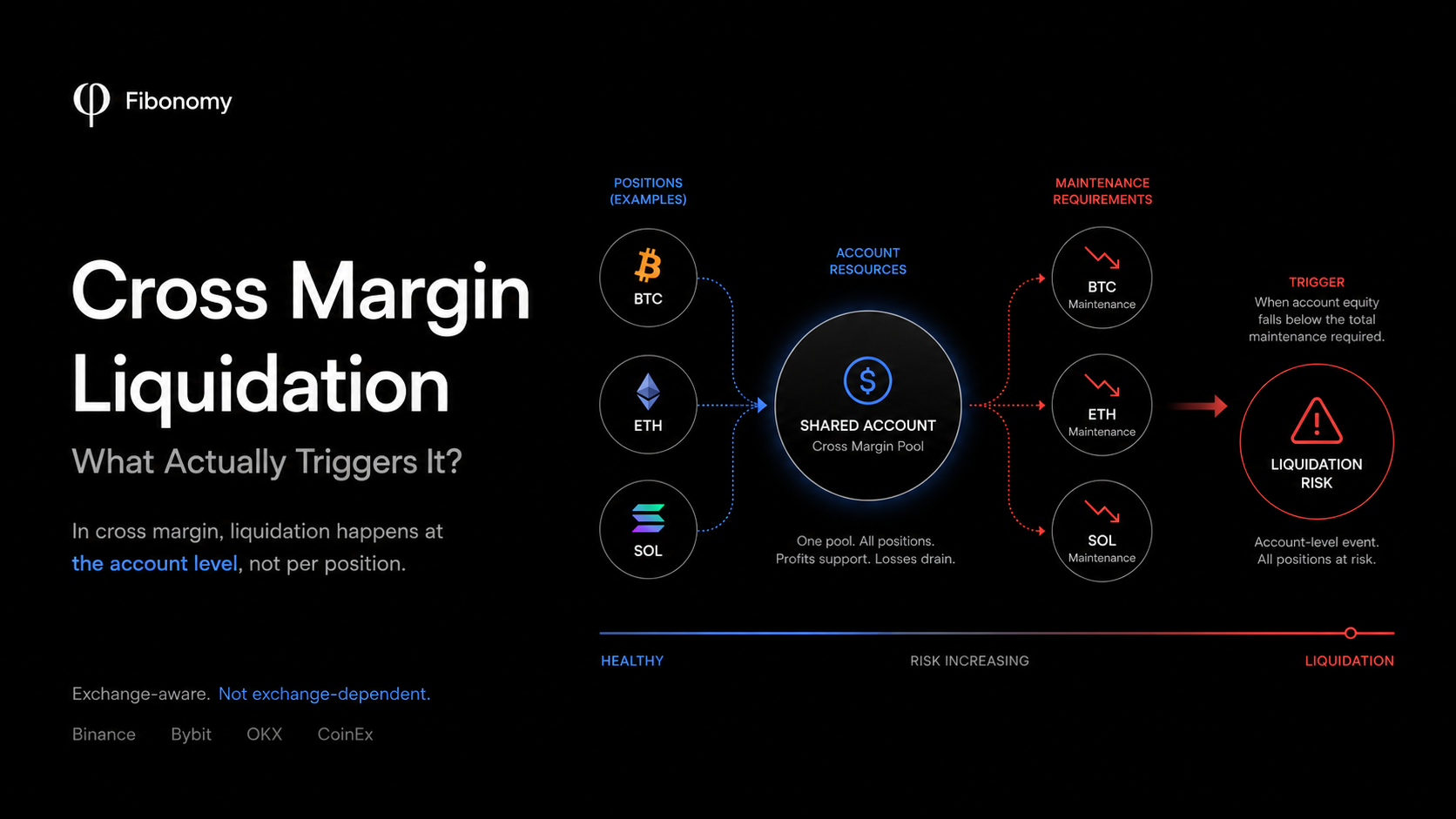
Cross margin liquidation is not always triggered by one position reaching one fixed price. It can be the result of the entire account moving beyond the exchange’s maintenance-margin requirements.
What actually triggered it?
The easy answer is:
“Price hit my liquidation level.”
In Cross Margin, that answer can be incomplete.
Your position is not sitting inside its own sealed box. It is sharing account resources with other positions, orders, P&L, funding, and margin requirements.
So the better question is:
What changed in the account until the exchange could no longer support the open risk?
That is what cross margin liquidation is really about.
Quick Answer
Cross margin liquidation happens when the account no longer satisfies the exchange’s required margin conditions.
Conceptually, every cross-margin account has two moving sides:
WHAT SUPPORTS THE ACCOUNT

Wallet / Margin Balance
+
Unrealized P&L
+
Eligible Collateral
+
Other Account Resources
versus:
WHAT THE ACCOUNT REQUIRES

Maintenance Margin
+
Position Requirements
+
Order Requirements
+
Applicable Fees / Liabilities
Risk gets worse when:
Account Support ↓
or:
Required Margin ↑
The worst case is both happening together:
Account Support ↓

AND

Maintenance Requirement ↑
But there is one important catch:
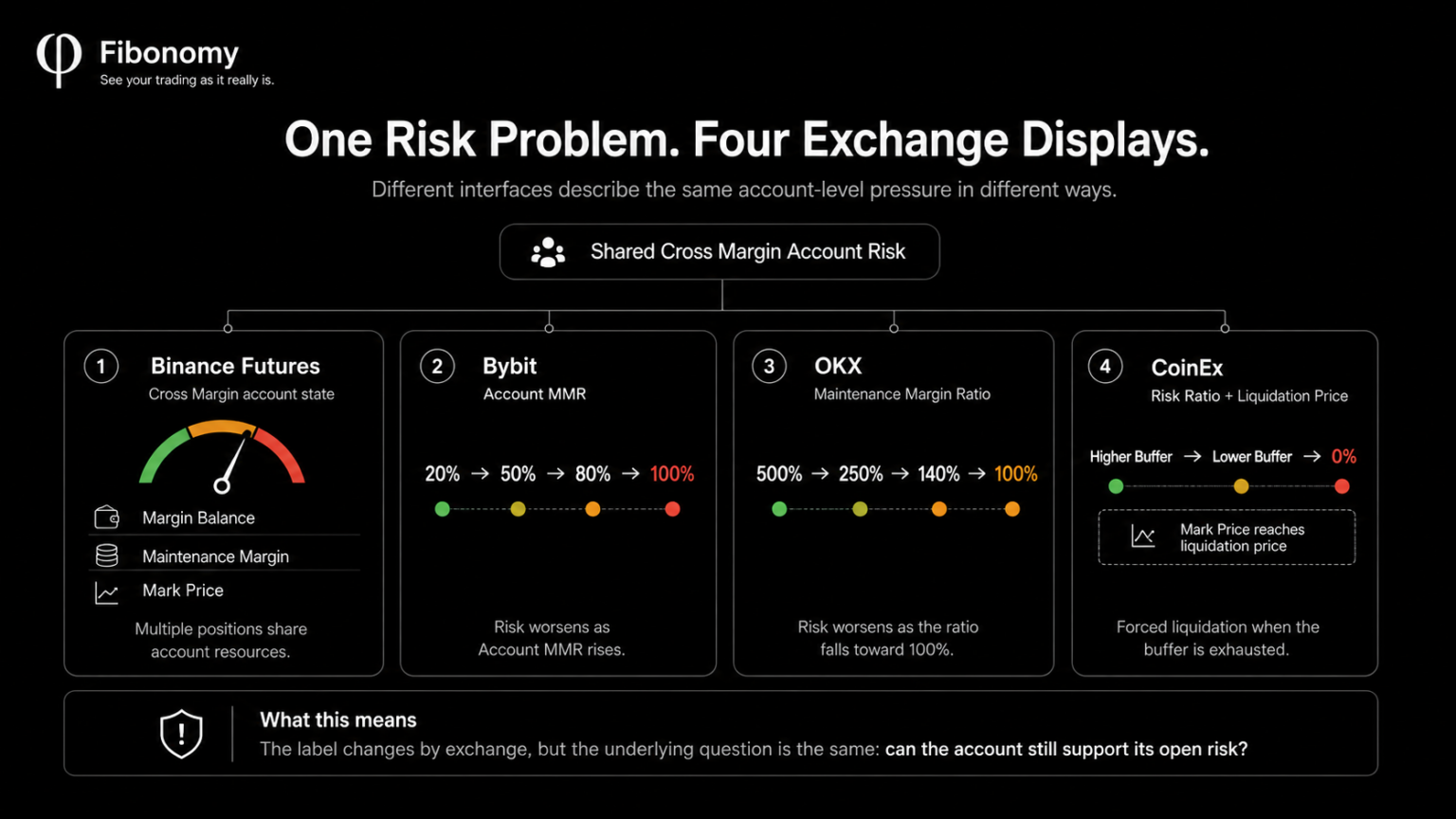
Binance, Bybit, OKX, and CoinEx do not expose this relationship in exactly the same way.
Bybit’s Unified Trading Account uses an account Maintenance Margin Rate (MMR); in Cross Margin, liquidation begins when Account MMR reaches 100%.
OKX uses a different ratio convention: its published cross-margin maintenance-margin ratio deteriorates toward 100%, with liquidation or position reduction possible when the relevant ratio reaches 100% or below.
CoinEx uses yet another representation: for its futures products, forced liquidation is tied to Mark Price crossing the liquidation price, while its documentation describes the risk ratio falling to 0% at forced liquidation.
Same underlying problem.
Different risk engine.
Table of Contents
Cross Margin Liquidation Is an Account Event
With Isolated Margin, the mental model is relatively clean:
BTCUSDT Position
       ↓
Dedicated Margin
       ↓
Position Liquidation
Cross Margin looks more like:
                 FUTURES ACCOUNT
                       │
                 Shared Margin
                       │
        ┌──────────────┼──────────────┐
        │              │              │
     BTCUSDT        ETHUSDT        SOLUSDT
       LONG           LONG           SHORT
        │              │              │
        └──────────────┼──────────────┘
                       │
                Account P&L
                       +
             Maintenance Margin
                       +
                Open Orders
                       +
                  Funding
                       │
                       ↓
                ACCOUNT STATE
                       │
                       ↓
                  LIQUIDATION
Bybit states this explicitly: under Cross Margin, all available margin inside the Unified Trading Account is shared across positions and orders, and liquidation risk is assessed at the account level.
CoinEx similarly says all available futures-account margin is shared across open Cross Margin positions.
That produces one of the most important distinctions in futures trading:
POSITION STATE
      ≠
ACCOUNT STATE
A position can look fine.
The account around it can still be getting weaker.
One Number Does Not Explain Cross Margin Liquidation
Suppose your exchange shows:
BTCUSDT Liquidation Price

$58,200
It is natural to think:
“As long as BTC stays above $58,200, I’m fine.”
That may be too simple.
The displayed liquidation price itself can change because the account state changes.
CoinEx says its Cross Margin liquidation price is recalculated when a trader:
- adds to a position,
- closes a position,
- adjusts leverage,
- or places a new opening order that reduces available balance.
It also notes that funding deductions can change the liquidation price by reducing margin balance.
Bybit goes further: in Cross Margin, the displayed liquidation price is explicitly for reference only. Actual liquidation is determined by the Account MMR rather than strictly by that displayed price.
So the liquidation price is better understood as:
OUTPUT OF CURRENT ACCOUNT STATE
not:
PERMANENT NUMBER FIXED AT ENTRY
We looked at this separately in:
Why Does My Liquidation Price Keep Changing in Cross Margin?
What Actually Pushes a Cross Margin Account Toward Liquidation?
There is rarely one cause.
Usually several moving parts are involved.
1. Unrealized Losses Reduce the Resources Supporting the Account
Start with:
Account Balance
$10,000
Three open positions:
BTCUSDT       -$500
ETHUSDT       -$700
SOLUSDT       +$100
Net unrealized P&L:
-$1,100
A simplified equity view:
$10,000
-
$1,100
=
$8,900
Nothing about position size necessarily changed.
Maintenance requirements may be similar.
But:
Resources Supporting Account

$10,000
   ↓
$8,900
So the same open risk is now being supported by less capital.
Bybit’s Cross Margin balance explicitly includes wallet balance plus perpetual and futures unrealized P&L.
This is why a losing ETH position can change the liquidation situation of BTC even when the BTC position itself has not changed.
2. Another Position Can Increase Risk Before It Loses Money
Now imagine:
Account Equity
$10,000
Current maintenance requirements:
BTC MM       $400
ETH MM       $300

TOTAL        $700
You open SOLUSDT.
The position is brand new.
Its P&L is roughly:
$0
But it requires:
SOL MM $500
Now:
TOTAL MAINTENANCE MARGIN

$700
  ↓
$1,200
The new position did not need to lose anything.
The account is already carrying more required margin.
Conceptually:
Account Support =
Maintenance Requirement ↑

        ↓

Less Room
This is why:
Opening another position can increase account risk before the new trade goes red.
For the full multi-position interaction, see:
How Multiple Open Futures Positions Affect Your Liquidation Risk
3. Sizing Up Can Change More Than Exposure
Suppose:
BTCUSDT Position

$10,000
becomes:
$50,000
The obvious change is:
Exposure ↑
But maintenance requirements can also change.
Binance uses notional and leverage brackets for futures positions. Its current material explains that larger notional exposure can move into brackets with lower allowed maximum leverage and higher Maintenance Margin rates.
That means:
SIZE UP
   ↓
Notional Exposure ↑
   ↓
Maintenance Requirement ↑
   ↓
Possible Risk Tier Change
   ↓
Liquidation Risk ↑
So changing position size is not merely changing potential P&L.
It can change the actual risk structure used by the exchange. Those size-up effects — average entry, capital at risk, maintenance margin, and liquidation price — are walked through in What Happens to Liquidation Risk When You Add to a Futures Position?.
4. Funding Can Change the Account While You Do Nothing
No new order.
No leverage change.
No position increase.
You are away from the screen.
Funding settles.
If the funding payment reduces the capital supporting a Cross Margin account:
Account Resources ↓
then liquidation conditions can deteriorate.
CoinEx explicitly notes that funding-fee deductions can lower margin and change liquidation price.
We covered the mechanism in detail here:
Can Funding Fees Move Your Liquidation Price?
This is a recurring rule worth remembering:
No trading action does not mean no account event occurred.
5. Open Orders Can Matter Before They Become Positions
This is easy to miss.
Imagine:
BTC position       unchanged
ETH position       unchanged
SOL position       unchanged
But you place a new opening order.
You may think:
“Nothing changed. The order hasn’t filled.”
Yet some exchanges reserve available margin for open risk-increasing orders.
CoinEx explicitly lists placing a new opening order as an event that can reduce available balance and recalculate the Cross Margin liquidation price.
Bybit also includes active orders in its account Initial Margin calculations.
So:
Open Positions
are not always the full margin picture.
You may need:
Open Positions
+
Open Orders
6. Leverage Changes Can Change the Risk Structure
A common mental model is:
10x → 20x

Just a leverage number
But leverage affects margin requirements.
Binance’s current futures documentation explains that leverage operates within notional brackets and that changing leverage can affect required margin and liquidation risk.
CoinEx also says adjusting leverage in Cross Margin triggers a real-time recalculation of allocated Cross Margin and may change both the risk ratio and liquidation price.
So the real chain can be:
Leverage Changed
       ↓
Required Margin Changed
       ↓
Available Margin Changed
       ↓
Account State Changed
       ↓
Liquidation Conditions Changed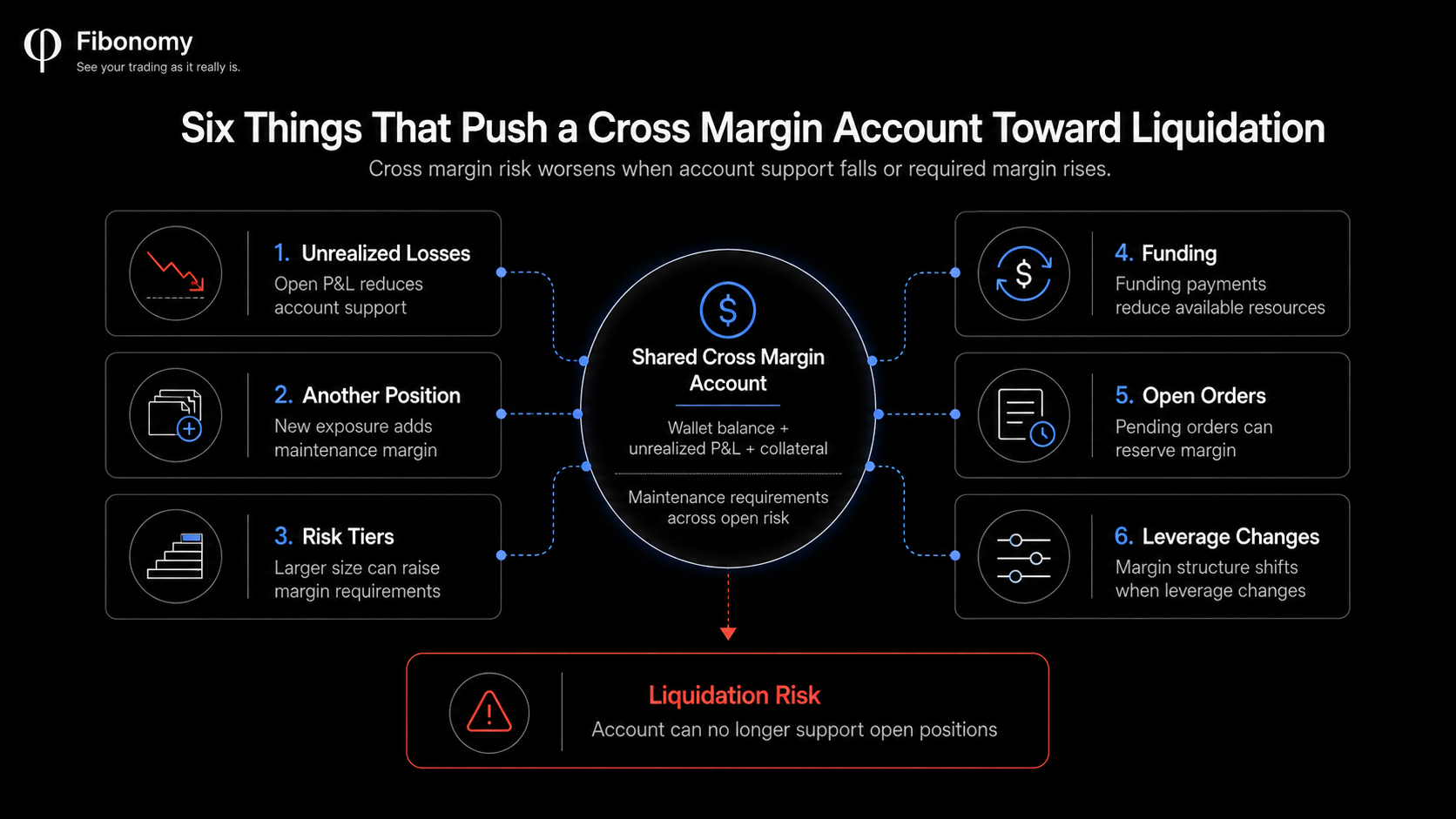
Same Problem, Different Exchange
This is where blindly copying one exchange’s explanation becomes dangerous.
The labels look similar.
The math does not always behave the same way.
| Exchange | Cross Margin Liquidation Signal | Direction Toward Danger |
|---|---|---|
| Bybit | Account MMR | rises toward 100% |
| OKX | Maintenance Margin Ratio | falls toward 100% |
| CoinEx | Risk Ratio / Liquidation Price | risk ratio falls toward 0%; Mark Price crossing liquidation price triggers forced liquidation |
| Binance Futures | Maintenance Margin, margin balance, Mark Price, leverage/notional brackets and product-specific rules | evaluate using Binance’s product/account-specific metrics |
Bybit
Under Bybit UTA Cross Margin:
Account MMR

20%
 ↓
50%
 ↓
80%
 ↓
100%

WORSE
When Account MMR reaches 100%, Bybit begins reducing account risk. Its staged process can include cancellation of orders, repayment of liabilities and liquidation of assets or derivatives positions.
OKX
OKX expresses the relationship differently.
Its published Cross Margin maintenance-margin ratio deteriorates downward:
500%
 ↓
250%
 ↓
140%
 ↓
100%

WORSE
At 100% or below, the account can enter position reduction or liquidation procedures.
Same threshold number.
Opposite direction.
CoinEx
CoinEx uses another representation.
Its current USDⓈ- and coin-margined documentation says that when Mark Price reaches the liquidation price, the risk ratio drops to 0% and forced liquidation is triggered.
Conceptually:
More Buffer
   ↓
Less Buffer
   ↓
Risk Ratio → 0%
   ↓
Forced Liquidation
Binance Futures
Binance is important because traders often search using exact UI language:
Binance Futures
USDT-M
Cross
Mark Price
Maintenance Margin
Liquidation Price
Margin Ratio
That language should appear naturally because it is how actual futures users search and communicate.
But Binance should not be treated as the universal formula for every exchange.
Its current futures material exposes:
- Cross and Isolated margin types,
- Mark Price,
- Futures account balances,
- unrealized P&L,
- Maintenance Margin,
- leverage,
- and notional/leverage brackets.
Larger position brackets can carry higher Maintenance Margin rates.
That means the correct question is not:
“What is the universal Cross Margin percentage?”
There isn’t one.
The correct question is:
“What metric does my exchange actually use to decide this account can no longer support its positions?”
A Worked Account Example
Forget exchange-specific formulas for a moment.
Look at the underlying account.
At 10:00:
Account Support
$10,000
Open positions require:
BTC Maintenance Requirement    $400
ETH Maintenance Requirement    $300
SOL Maintenance Requirement    $300

TOTAL                         $1,000
For teaching purposes:
Support            $10,000
Requirement         $1,000
Do not treat the ratio below as a real exchange formula.
We are only using it to make the mechanics visible.
Now BTC and ETH move against you.
At 10:30:
Account Support

$10,000
   ↓
$7,000
Maintenance requirement remains:
$1,000
The account already has less room.
Then at 10:45 you size up SOL.
Additional maintenance requirement:
+$1,000
Now:
Account Support      $7,000

Required Margin      $2,000
Compare:
10:00

Resources      $10,000
Requirement     $1,000
with:
10:45

Resources       $7,000
Requirement     $2,000
Nothing about that story requires a magical liquidation number.
Two things simply moved against the account:
Resources ↓

AND

Requirements ↑
That is the heart of Cross Margin liquidation.
Why Mark Price Matters
Another source of confusion is the candle.
A trader watches:
Last Pricewhile the exchange’s liquidation engine may rely on:
Mark PriceBinance describes Mark Price as a fair-value mechanism designed to reduce unfair liquidations caused by temporary volatility or abnormal Last Price movements.
Bybit explicitly uses Mark Price as the liquidation trigger reference rather than Last Price.
OKX also says its liquidation calculation is based on Mark Price.
CoinEx uses Mark Price to trigger forced liquidation as well.
So this trader complaint:
“The candle never hit my liquidation price.”
is not enough evidence to conclude the liquidation was wrong.
First check:
Which price was I watching?

vs

Which price was the risk engine using?
We covered that distinction in:
Why You Can Be Liquidated With a Stop Loss
Cross Margin Can Look Safer While Exposing More of the Account
This is one of the most dangerous misunderstandings.
Cross Margin can push an individual liquidation price farther away because more account resources are available to support the position.
That feels safer.
But compare:
ISOLATED

Position
↓
Dedicated Margin
with:
CROSS

Position
↓
Entire Shared Futures Margin Pool
A farther liquidation price does not automatically mean:
Lower Account Risk
It can mean:
More Account Capital Available
to Keep the Losing Position Alive
CoinEx explicitly describes Cross Margin as sharing all available Futures-account margin across open positions.
Bybit similarly uses the whole available account margin across Cross positions and orders.
This distinction matters:
Position survival and account safety are not the same thing.
What Happens When the Threshold Is Reached?
Another misconception:
Threshold reached
       ↓
Everything instantly closes
Not necessarily.
Bybit documents a staged process.
At Account MMR = 100%, the system can begin with actions such as:
Cancel orders
      ↓
Handle liabilities
      ↓
Re-evaluate account
      ↓
Reduce / liquidate positions
If these actions bring MMR back below the threshold, later liquidation stages may stop.
OKX similarly documents cancellation of open orders and position reduction before or during liquidation.
CoinEx states that pending orders using the same margin asset can be cancelled during forced liquidation to prevent further risk escalation.
So liquidation is better understood as:
EXCHANGE RISK-CONTROL PROCESSnot merely:
PRICE TOUCHES LINEIf Your Cross Margin Risk Suddenly Gets Worse, Check This
Do not begin with the liquidation price.
Reconstruct the account.
1. Unrealized P&L
Which positions just moved?
BTCUSDT?
ETHUSDT?
SOLUSDT?
2. Account Equity or Margin Balance
How much capital is actually supporting the account now?
3. Maintenance Margin
Did the requirement increase?
4. Position Size
Did you scale in?
5. Risk / Notional Tier
Did a larger position move into another maintenance bracket?
6. Funding
Did funding settle?
7. Open Orders
Is margin being reserved for a position that has not opened yet?
8. Leverage
Was leverage changed?
9. Transfers or Collateral Changes
Did money leave the Futures account or did eligible collateral change?
10. Mark Price
What price is the liquidation engine actually evaluating?
That sequence is far more useful than staring at:
Liq Price:
$58,210
and asking what went wrong.
The Better Question
Do not ask only:
“Why did I get liq’d?”
Ask:
“What changed between the last healthy account state and the moment the exchange took control?”
Reconstruct:
Account resources

        ↓

Open-position P&L

        ↓

Maintenance requirements

        ↓

Position changes

        ↓

Funding

        ↓

Orders

        ↓

Mark Price

        ↓

Liquidation threshold
Now the event has a history.
And that history is usually more useful than the final liquidation price.
The Bottom Line
Cross margin liquidation is not one universal formula.
Binance, Bybit, OKX, and CoinEx expose different metrics and use different account structures.
But underneath those differences is the same basic pressure:
The account has resources.

The open risk has requirements.

When the first can no longer support the second,
the exchange's liquidation system takes control.
Your account can move toward that state because:
- unrealized losses reduce equity,
- another position increases required margin,
- position size moves into a higher risk tier,
- funding reduces available resources,
- open orders reserve margin,
- leverage changes the margin structure,
- or Mark Price moves against the position.
That is why the better question is not:
“What is my liquidation price?”
It is:
“What is happening across my account that is moving me toward liquidation?”
That is the truth the single number cannot show you.
See What Is Driving Your Account Toward Liquidation
Fibonomy brings your open positions and account state together so you can see what changed, which positions are contributing most to risk, and what is happening to the capital supporting them.
See My Positions →
Not a signal. Perpetual futures can produce losses quickly, including liquidation. This content is educational and does not constitute financial, investment, or personalized trading advice.
Sources
Binance Academy — What Are Perpetual Futures Contracts?
Mark Price, Maintenance Margin, unrealized P&L, liquidation, funding and perpetual-futures mechanics.
Binance — Futures Liquidation Protocols (Mark Price)
Current Binance Futures terminology including Mark Price, Futures account balance, Cross/Isolated Margin and position-management data.
Binance Academy — Open Position Leverage and Notional Brackets
How position notional, leverage brackets and Maintenance Margin rates interact.
Bybit — Unified Trading Account Overview
Margin Balance, Equity, Maintenance Margin and Account MMR.
Bybit — Trading Rules: Liquidation Process
Cross Margin account-level liquidation and the staged risk-reduction process.
Bybit — Order Execution and Liquidation FAQ
Mark Price and reference liquidation prices in Cross Margin.
OKX — How Does Liquidation Work in Futures Trading?
Maintenance Margin Ratio, continuously changing liquidation estimates and Mark Price.
CoinEx — Cross vs Isolated Margin
Shared Cross Margin across Futures-account positions.
CoinEx — Liquidation Price for USDⓈ-Margined Contracts
Cross Margin liquidation formula, recalculation events, funding impact and risk-ratio behavior.
CoinEx — Forced Liquidation
Mark Price triggering and forced-liquidation process.